Blitzy's Blitz: Adventures in Chess
Jul 09, 2026 • Carly Levinsohn & Michael Montanaro • 2 min read
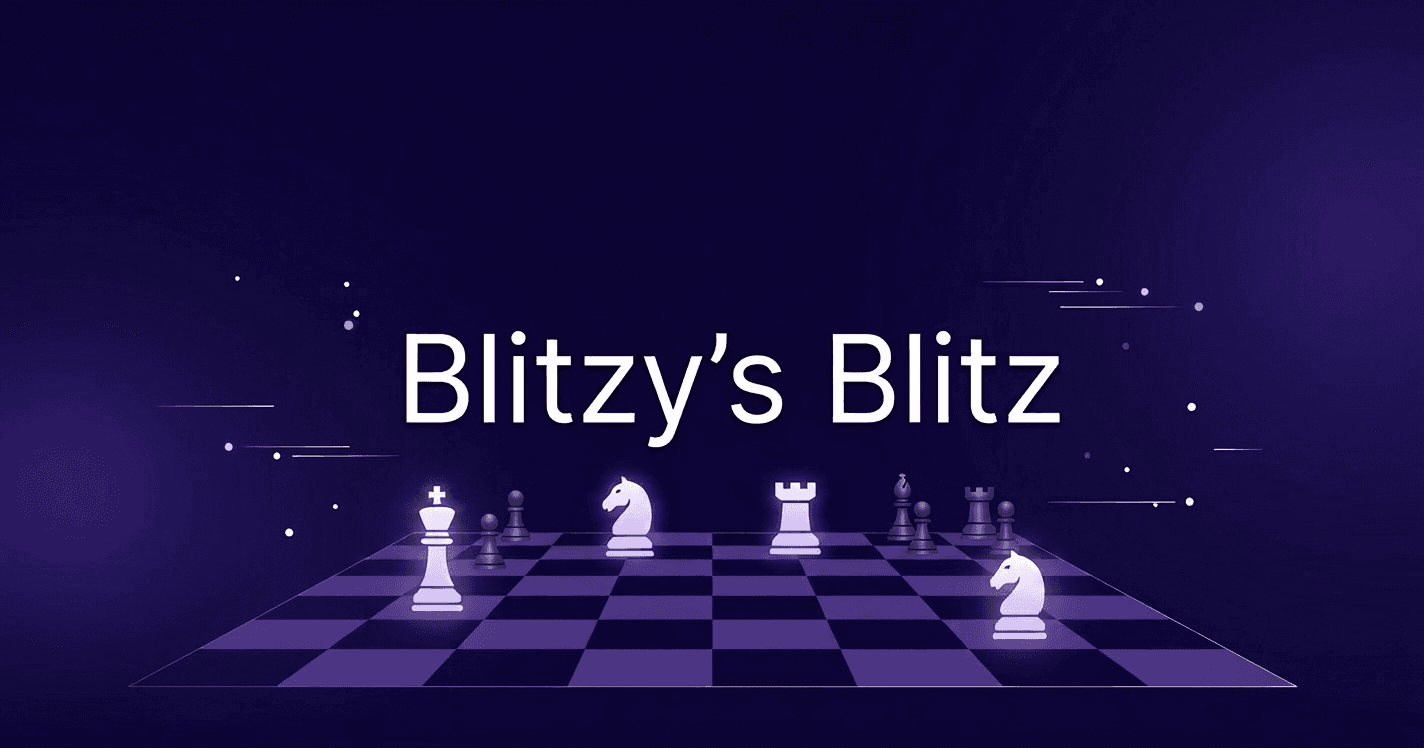
The first move of a chess game: 1.e4. King's pawn.
A textbook opening for white to seek control of the board's center… one of many possibilities.
Black's turn. Twenty different options for a first move to set the cadence and tone. How will the opponent respond?
Every game is divided into three tactical parts:
- The opening
- The middle
- The endgame
The board lays the context for each turn. Like any sequence, sections build on one another, and combinations become more deterministic and restrictive as a matchup progresses.
You are probably wondering why this Blitzy blog opened with a chess match's first move? It's a fair question.
The answer is straightforward.
This week's blog compares the results of a prompt triggering a Blitzy run and Claude Code to build the same chess app. We are running through the resulting differences and why Blitzy picked a proactive defense in the app's development process.
The Middlegame & Downstream Failures
The opening sets the scene for how the match is going to be played. Without a thoughtful approach to your side's formation, the board will continue to shift the odds in favor of your opponent.
One move follows another, and the board you stand on continues to shift beneath you. As the game progresses, there will be moments and decisions for sacrifices to dial the pressure within the competition. The best players are able to map what subsequent moves are required after an attack is initiated, determining whether or not the outcome is positive or negative for their position on the board.
The challenge becomes seeing all those possibilities and continuing to recalculate the possible moves as the board and the underlying context of the game changes. The board's present state and how it continues to evolve has compounding effects on the outcome of the game. Blitzy's approach is one of slow and calculated maneuvers as the agents navigate the unstable nature of ever-evolving context. Claude Code leads with this instability.
The true game becomes the simulation that occurs in the winner's head.
Validation As Endgame
As the moves slow down, the need to play through the various possible iterations has a direct correlation to the game's outcome. Your pieces work to create deterministic combinations while defending against the progress of your opponent. The player who runs through the most scenarios, more often than not, will come out victorious.
A minor swing in momentum has a significant impact on the outcome.
Game Recap & Audit Trail
How did this challenge play out?
Blitzy tackled the request with a clear plan in mind, executed, and got the results it expected: a pure game with a mature CI/CD pipeline and an automation suite to run, record, and validate the engine's ability to play the game with an option to challenge your friends.
Claude Code was given the same challenge and decided to omit requirements. The starting positions did not follow regulation, and with that, the game was never realized.
From standardized openings to mathematically solvable end positions, chess is an incredibly well-defined problem set.
The challenge is one of context. Some can play that game; others cannot.
We are playing different games.
Enjoy your checkers, Claude Code.