Blitzy logo
OverviewUse-casesSecurity
Company
DocsBlogVideos
Pricing
OverviewUse-casesSecurity
Company
DocsBlogVideos
Pricing

From Comment to Chrome Extension

Apr 01, 2026 • Sam McGeachie • 3 min read
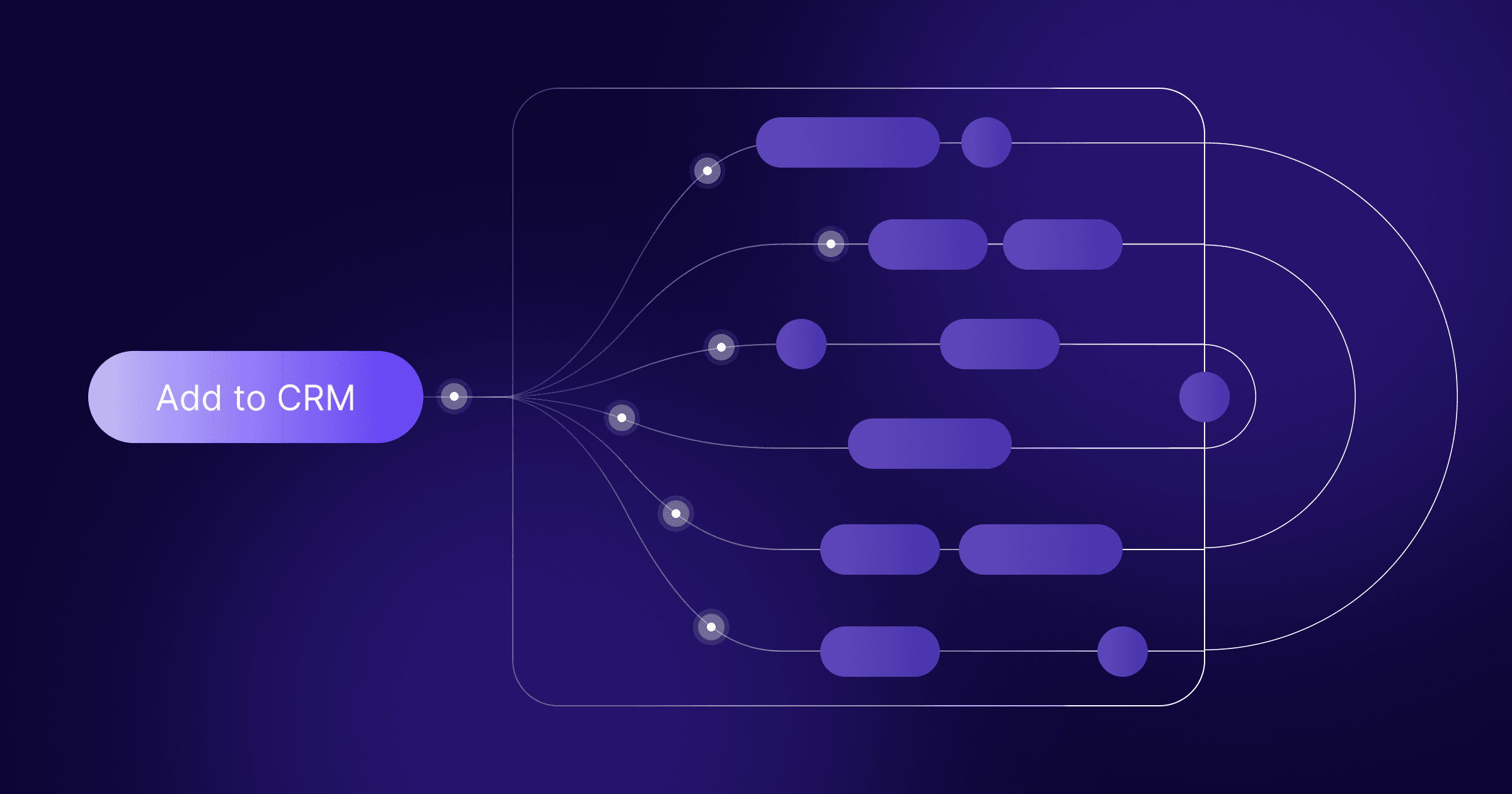
From Comment to Chrome Extension

A LinkedIn CRM Integration Built with Blitzy

My development story started with a comment in a sales meeting.

The sales team was discussing their current workflow: what's working, what isn't, and possible bottlenecks in the cycle to address.

At Blitzy, like many other companies, software is an integral part of organizing and maintaining customer relationships. Acknowledging technology's role in creating efficiency for the sales cycle, Matt, a sales representative, offhandedly mentioned an idea for an internal feature to streamline their workflow.

Inspired by Apollo's Chrome Extension, a Blitzy-internal feature where sales reps could click a button on a LinkedIn profile to instantly add someone's enriched contact data to the CRM would accelerate productivity considerably. Without functionality like this, sales reps could spend 25% of their work week doing administrative tasks like updating contact information, data entry and CRM hygiene.

I told Matt I could probably build it.

That weekend, I did.

Identifying Feature Scope

Before jumping into any code, I needed to understand the technical requirements. I opened a conversation with Claude to help me break down what the extension would need based on the sales team's feedback.

Here's what I came up with:

  • A content script to inject a button on LinkedIn profiles
  • A backend to handle CRM writes and contact enrichment
  • An authentication layer so each rep could use it securely

I drafted a prompt thorough enough for Blitzy to take on the full project in a single run. The prompt covered the Chrome extension scaffolding, LinkedIn DOM integration points, backend API design, and the CRM data model.

What Blitzy Built

I submitted my prompt to Blitzy on Wednesday night. After two days, code generation was complete.

When the run finished, I spent Saturday afternoon QA testing the button placement on LinkedIn. The extension needed to inject a clean, intuitive button directly onto profile pages without breaking LinkedIn's existing layout. I found a couple of issues with positioning and fixed them up.

From there, I built out the backend, connected the CRM and Clay integrations, and had the whole thing up and running.

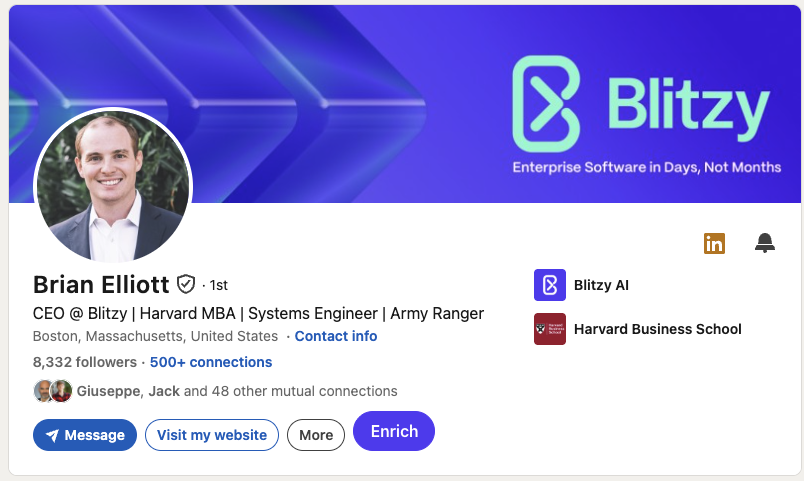
The button is depicted below:
Enrich button

Click the purple "Enrich" button on any LinkedIn profile, and a contact is created in our CRM with enriched data from Clay. A corresponding Slack message is sent to the sales rep with the enriched data enclosed.

A Blitzy Refinement Run

The extension worked... until I invited other team members. The onboarding flow was not functional.

Rather than spending hours manually debugging the damage, I ran a refinement through Blitzy. The platform holds the full context of our codebase and understands the relationships between edge functions, the authentication layer, and the extension logic. Blitzy identified and resolved all the issues.

The extension worked!

I was able to send out invites, onboard my reps, and get the team using it right away. The Chrome extension is live and used across the Blitzy sales team.

Why This Matters

The whole project, from a passing comment in a sales meeting to a production Chrome extension used daily by the team, took a weekend of hands-on time. Blitzy handled the engineering effort.

There is a meaningful difference between a copilot and an autonomous development platform like Blitzy. A copilot would have required me to sit in a code editor and manage every integration point manually. With Blitzy, I submitted a prompt, went about my Saturday, and came back to a working Chrome extension. When things broke, the platform fixed that too.

The Chrome extension was not a proof of concept. What I built solves a real problem for the sales team, saving each sales rep on average eight to twelve hours a week.

Features like my extension could sit in a backlog for months, waiting for engineering bandwidth to make the project feasible. Blitzy made it possible to act on the idea immediately, building and shipping a solution in days.

What is sitting in your backlog that could be built this weekend?

Curious what you could build with Blitzy? Let's chat.
More from the blog

View all
How Blitzy Optimized Our GTM Team

How Blitzy Optimized Our GTM Team

Jun 04, 2026 • Carly Levinsohn • 3 min read

A Quick Blitzy Chat:  3 Codebases’ Takes on Prompting

A Quick Blitzy Chat: 3 Codebases’ Takes on Prompting

May 28, 2026 • Carly Levinsohn • 7 min read

Frequently asked questions

What is Blitzy?

toggle button

Blitzy enables development teams to transform six-month software projects into six-day turnarounds using Blitzy OS, an agentic platform that enables thousands of AI Agents to 'think' and cooperate for hours to bulk build software with precision. The platform builds everything AI can deliver in a precise manner, around 80% of any roadmap or new product, supplemented with a human engineering guide to complete the remaining 20% needed for production. With over 27 patents and counting, Blitzy is actively hiring PhDs and senior developers in Cambridge, MA who have a passion for building AI that leverages 'System 2 Thinking' to solve problems at inference.

Who is Blitzy for?

toggle button

Enterprises that aim to dramatically accelerate their software development velocity, development agencies with enterprise clients, development teams with complex existing products, and individuals looking to accelerate their own velocity on complex builds.

How does Blitzy's technology work?

toggle button

Our patent-pending code ingestion framework maps a curated selection of robust, reliable, and secure open source software libraries that we track by version and update frequently. Combined with our proprietary code generation technology that specializes on enforcing enterprise-class software policies, Blitzy far exceeds the utility of typical chatbots and co-pilots in creating production-ready software at scale.

Is Blitzy a coding co-pilot?

toggle button

Nope. Blitzy surpasses traditional co-pilots with its ability to autonomously generate nearly-complete code repositories, not just snippets. It features a daily-refreshed knowledge base, avoiding the pitfalls of outdated information. Blitzy's proprietary codebase representation system enables deep understanding of generated code, offering highly contextual and relevant suggestions for your entire repository.

What's my role in Blitzy's development process?

toggle button

Your team is responsible for bringing the requirements, and as an approver during the technical specification stage. We ask you to edit/approve the Technical Specification. The document is editable, so you can edit and approve to get exactly what you had in mind.

How does Blitzy decide which tasks to delegate to human developers?

toggle button

Blitzy's multi-agent system is meticulously and rigorously trained to know what it can accomplish, and what needs to be left for the human engineers. This ensures you only receive quality code and have a clear picture of remaining tasks.

Does Blitzy do more than just autonomous code generation?

toggle button

Yes. Blitzy is a comprehensive platform that provides end-to-end development assistance. We support the entire development lifecycle by taking descriptive inputs and generating software requirements documents, technical design, code structure, and generative code within repos for your product.

Is this high quality and secure?

toggle button

Quality and Security matter A LOT to us, and was one of our biggest frustrations with the co-pilots we tried on the market. This was the inspiration to develop a system trained to deliver enterprise quality. We train our agents to operate with enterprise standards with multiple QA agents checking each others work before you ever receive a line of code. Ultimately, we provide high quality code repositories, but your team should QA/QC, including testing security.

What is the typical cost of your solution?

toggle button

Blitzy uses a two-phase pricing model: evaluation followed by deployment. This structure enables enterprises to validate ROI at their preferred scale before committing to organization-wide implementation. The evaluation phase provides three options. Reverse Engineer ($0) offers an initial assessment with complete codebase reverse engineering and understanding up to 100K lines of code, Proof of Concept ($50K for 2-month term) where Blitzy delivers a guided POC to demonstrate value, or Structured Pilot ($250K for 6-month term) which fully deploys Blitzy in your environment with 5M lines onboarding and 1.25M lines generation to prove production readiness. Following successful evaluation, organizations choose between three deployment paths. Commercial ($500K typical investment per year) adopts Blitzy on one team to accelerate a defined initiative, with 20M lines onboarding included and $0.10 per line for additional onboarding, dedicated infrastructure, and SAML-SSO. Enterprise ($5M typical investment per year) rolls Blitzy out across your engineering organization with 50M lines onboarding at $0.10 per line, a Dedicated AI Solutions Consultant, and 2 Forward Deployed Engineers. Transformation ($50M typical investment per year) provides infinite code context, custom deployment, and embedded teams including a Field CTO, Dedicated AI Solutions Consultant, 6 Forward Deployed Engineers, and 2 Forward Deployed Designers for complete digital transformation. All tiers maintain SOC 2 Type II compliance, ISO 27001 Certification, and guarantee no training on your code. Pricing operates on a usage-based model at $0.20 per line generated, aligning costs directly with value delivered.

After submitting my prompt, Blitzy added functionality in my tech spec that I did not expect. What do I do?

toggle button

The system defaults to taking advantage of all technology upgrades when modernizing or upgrading to the latest technology stack. For example, if you specify an upgrade to Java 21, the system will by default implement virtual threads, as it's generally seen as a superior technical approach. If you do not want this, you must simply tell the system to 'make as few changes as possible to achieve the desired request'. Being as specific as possible about what functionality is (and is not) desired helps yield results that will align with expectations.

What do Blitzy agents rely on as a source of truth to represent my existing codebase?

toggle button

Blitzy agents rely on the actual source code of your existing codebase—not the Tech Spec documentation—when performing refactors or extending functionality. However, an accurate Tech Spec significantly aids the system's efficiency in querying the underlying representation of the code. Therefore, investing time to ensure the Tech Spec reflects the core features of the application will yield expectation-aligned results and will save time with last-mile development.

Can Blitzy work with existing products and code bases?

toggle button

Yes! Blitzy excels at working with existing codebases, using them as a foundation to ensure consistent, high-quality development. The platform enables you to add new features to existing products, generate comprehensive documentation, and tackle technical debt by upgrading legacy systems to state-of-the-art technologies or refactoring complex codebases. Our platform deploys dedicated AI agents that map and understand your codebase before generation, ensuring intelligent, contextualized development that aligns with your existing patterns and standards.

What programming languages does Blitzy support?

toggle button

Blitzy's AI platform works with all programming languages.

How should I structure my prompts for Blitzy?

toggle button

Structure and organization are crucial when prompting Blitzy. The most effective prompts follow our prompting template with clear sections for WHY (vision & purpose), WHAT (core requirements), and HOW (technical details, user experience & implementation priorities). Each section should be detailed but concise, focusing on essential information while providing relevant context. Including structured frameworks and concrete examples - like data models, user stories, or feature templates - helps Blitzy deliver more precise and purposeful solutions.

What information does Blitzy need to compile and run my code?

toggle button

During code generation, Blitzy compiles your codebase and performs runtime validation to ensure the generated code works correctly. To enable this, we require: (1) Internal dependencies - any private packages, libraries, or binaries not publicly available that your code needs to build and run, (2) Environment variables and secrets - API keys, credentials, and configuration values required for compilation and runtime (shared securely through our encrypted UI, never exposed to AI agents), and (3) Build instructions - the specific steps or scripts needed to compile your code, typically found in your README or setup documentation. This information allows Blitzy to replicate your development environment and verify that all generated code functions properly before delivery.

How can I exclude certain files or folders from Blitzy's code generation?

toggle button

Create a .blitzyignore file in your repository's root directory to specify which files or paths Blitzy should exclude during tech-spec generation and code generation. This works similarly to .gitignore - simply list the file patterns, directories, or specific files you want Blitzy to skip, using standard gitignore syntax like *.log, /build/, or config/secrets.json. To ensure Blitzy respects these exclusions, mention in both your codebase context prompt and target state prompt that Blitzy should reference the .blitzyignore file and exclude those paths from processing.

Can I cancel my project/job (code gen) once in progress?

toggle button

At this time, jobs are not cancelable. Once you submit, it consumes the assigned quota.

Build enterprise software in days, not months.

Start buildingTalk to an expert
Blitzy

Blitzy

One Kendall Square,

Cambridge,

MA 02139

© 2026 Blitzy. All rights reserved

Product

  • Overview
  • Use-cases
  • Security
  • Pricing

Company

  • About us
  • Careers

Support

  • Help
  • Service status
  • Trust center

Resources

  • Docs
  • Blog
  • Videos

Social

  • YouTube
  • LinkedIn

Legal

  • Terms of use
  • Privacy policy